Biography
A brief biography featuring his studios, commercial, and experimental work with the super models and celebrities of mid century Madison Avenue.
Early years
Hudson, NY to New York City—Growing up, a name change, and World War II
William Bell was not his name.
He was born August 1, 1921 and lived in Hudson, NY where his father owned a dry cleaning business. Bobbi, his daughter recalls, “William Bell was not his given name although I do not know when he changed it. I believe his father changed the family name. My father’s siblings all went by Bell.”
In fact it was only after his death on Veterans’ Day in 2012 that she discovered his birth name was Israel Belofsky. “He never shared this information with me or anyone including my mother.” Israel’s mother died when he was six. He continued living with his father, stepmother, two stepbrothers and stepsister until he was 13. After his Bar Mitzvah he ran away from Hudson to live with his sister and her husband in New York City until he joined the army.

“My father spoke little about his Cinderella childhood or his education. I believe that he never graduated from high school.” He had a a stormy relationship with his father, stepmother and step siblings, and he likely changed his name as he began to sense that Manhattan was his destiny and Madison Avenue was where he would discover his profession and identity..
The Tenth Mountain Division
During World War II Bell served in the famed 10th Mountain Division. There he learned to ski. Skiing became a lifelong source of adventure and recreation and social activity as well as the setting for many of his commercial shoots.
Stationed in Europe and then in the Aleutian Islands, he took his camera to war and set up a dark room so he could develop film. He took photos of his platoon mates to send to wives and girlfriends.

U.S. Army 10th Mountain Division
His daughter remembers hearing that his best friend had been killed by friendly fire. “He kept in touch with his friend’s mother and she sent him a quilt she had made for him. This became mine for most of my childhood. “
Bell and Pauline Chelmow met before he joined the army. They corresponded as friends, but their romantic relationship blossomed when he came home on leave.
Injured in a battle in the Aleutian Islands (with Canadian troops!) near the end of the war, he returned home. They married on July 22, 1945.
He was then stationed in Texas where he worked in a Veterans Administration hospital as an occupational therapist. He taught wood carving, creating figures of skiers. He melted toothbrushes for pigment to color the figures.
They returned to Pauline’s family in the Bronx, and his daughter writes, “I was born in May, 1946. We lived with my maternal grandmother until GI housing was available. Then we lived in a Quonset hut in Queens with other GI’s and their families.”

Making a living
Bell’s first professional photography job was night club photographer at the Stork Club.

In the early 1950’s more housing became available and we moved to an apartment in the Bronx, Bobbi recalls. Now three, the Bells moved into an apartment near Pauline’s family.
From assistant to chief photographer
RUSSEKS DEPARTMENT STORE
Fifth Avenue, New York City
William Bell was hired as a photographer’s assistant at Russeks Department Store on Fifth Avenue. He said that this was the real beginning of his career as a fashion photographer.

The staff photographer quit suddenly, and Bell filled in temporarily. This position became his until Russeks discontinued in house advertising.
The studio in Russeks was large and well equipped. Bobbi, his daughter recalls, “As a 6 year old I spent several Saturday mornings hanging out. My father would roll out a seven foot section of n-seam paper and hand me a box of pastels while he worked in the dark room. I also had free reign in the dressing room with the costume jewelry. Lunch would follow at a local Italian restaurant.
“On two occasions I modeled for him and appeared in the Sunday New York Times.”

Camera
Bobbi still has the camera William Bell used in his work in the 1950’s… a large format camera… likely the one he used for his photo shoots with Marilyn Monroe and Audrey Hepburn.

Avedon Studio
Third and 49th, New York City
Richard Avedon noticed him and invited him to join the Avedon atelier, managing his own studio and taking on Avedon’s commercial work as Avedon focused on fine art photography. Bell applied his expertise to lighting set ups, set design, test shots, and technical work. Hiro Wakabayashi was one of Bell’s assistants there.

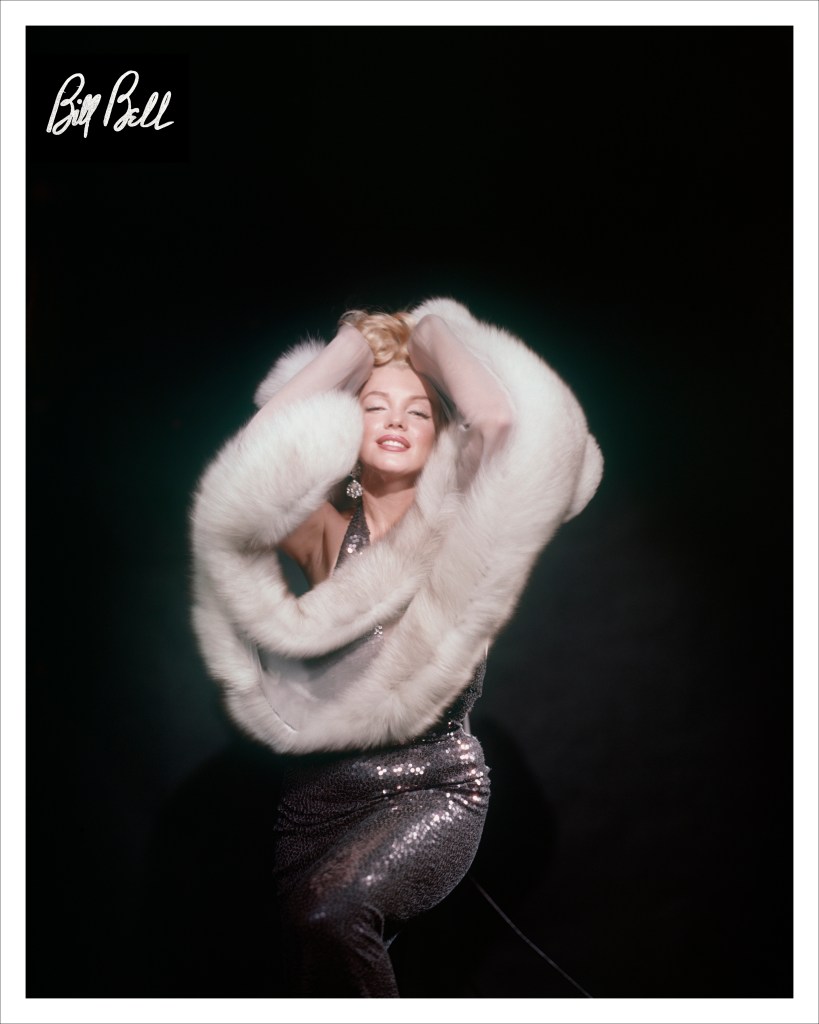
1952 is the year in which Bell set aside eight 8×10 large format color transparencies in a Kodak box where he wrote, “important.” Marilyn Monroe had arrived, and William Bell photographed her, in his studio, as the emergent icon. He set up special lighting and evoked the show girl in several remarkable shots where she’s wearing costumes for the movies where she first cast her spell. This shoot was possibly the first time she was photographed in New York City.

©2025Roberta Bell Liepolt
After William Bell’s death, 60 years later, his daughter and grandson James discovered the box labeled “important,” and, opening it, saw the 8”x11” 1952 camera color transparencies of the test shots Bell had made of Marilyn Monroe. They had never been printed, never been published. The daughter and grandson were first to see them in six decades.
Bell had spoken of the shoot recalling that Monroe had arrived early and offered to sit for him, but he had never printed or shared the photos. He brought home a wool chamisol given him by Monroe. His daughter, then 8 years old, owned and wore it until it was worn out more than a decade later.

Earl Steinbicker, Avedon’s longtime assistant published a map and description of the 49th Street studio:
Steinbiucker writes: In the diagram above, the numbered rooms were used as:
1. Reception. This was the domain of his secretary, Polly Hatch.
2. Avedon’s studio. There was a skylight above the large frosted glass window, which together yielded beautifully textured natural light with a clean white background. That window is no longer there. At other times we used tungsten studio lighting, and even experimented with Ascor studio strobes in 1956.
3. Studio of associate photographer Bill Bell. Avedon also used this studio at times, and it was later used by another associate photographer, Hiro Wakabayash, Bell’s former assistant.
4. Models’ dressing room.
5. Work area, where negatives were numbered, prints mounted, and so on.
6. Office of Avedon’s representative, Laura Kanelous.
7. Rest room.
8. Film darkroom, where B&W film was processed.
9. Finishing room, with film drying cabinet, print washer, and rotary Pako print drier.
10. Print darkroom, fitted with an Omega D-2 4×5 enlarger, a Pako contact printer, and a monster Saltzman 8×10 enlarger.
Bobbi recounts that during his time at Third and 49th Bell began to build his reputation, his portfolio, and a group of loyal clients.
As he gained experience and confidence, William Bell came to the realization that he needed and wanted to run his own studio his own way. “He hired his own agent, and—much to my mother’s dismay—…
“Struck out on his own!”
William Bell’s Studio
East 49th, New York City
His studio was on East 49th street between Park and Madison, in the Manny Wolf building…
Bobbi writes, “My mother began working for him as his bookkeeper and receptionist. However, he soon needed a stylist and assistant as his business was booming. “
Vogue
From 1958 to 1961, Bell contributed four covers, over a hundred and twenty photographs, in thirty-two editorials to Vogue Magazine. He worked closely with Alexander Liberman who encouraged Bill… entrusting him with complex and demanding assignments and suggesting he teach at the New School. Liberman shepherded many of the talented photographers who defined The Golden age of Fashion Photography, William Bell with an impressive list of editorial projects at the end of the 1950’s and beginning of the 1960’s not least among them.
Formative years
Alexey Brodovitch’s Design Laboratory was the legendary course taught at The New School for Social Research that deeply connected the mid-century photography of William “Bill” Bell to editorial giants like Alexander Liberman.
While Brodovitch (the famed Art Director of Harper’s Bazaar) was the master instructor of the course, mid-century fashion photographers like William Bell, Richard Avedon, and Lillian Bassman used the workshop as an avant-garde incubator to experiment with radical layouts, cinematic pacing, and stark graphic lighting.
The Nature of the Course & Bell’s Involvement
- A Bridge Between Rivals: Although the Design Laboratory was closely associated with Harper’s Bazaar, the experimental photography generated there caught the attention of Alexander Liberman at Vogue. Liberman frequently recruited talent directly from this artistic circle, selecting William Bell to shoot major Vogue editorials and high-profile covers throughout the late 1950s and early 1960s.
- Breaking Traditional Rules: The course pushed photographers away from rigid commercial imagery. Under this influence, Bell’s work evolved to feature models in motion, high-contrast geometry, and playful, storytelling compositions (such as his famous 1959 Vogue feature “Two Models With Dogs” or his striking covers featuring Anne St. Marie).
- Typographic and Visual Poetry: The emphasis on blending text and imagery taught in the course led to unique side collaborations for Bell.
As one of the group who shaped the golden age of American fashion photography, Bell photographed many of the era’s leading models, including Suzy Parker, Dorian Leigh, Dolores Hawkins, Anne St. Marie, Sunny Harnett, Dovima, Evelyn Tripp, Sandra Church, and Dorothea McGowan.
With Bell‘s expertise and innovation. Liberman focused heavily on breaking away from static studio portraits and leaning into graphic, dynamic layouts.
As the legendary Editorial Director of Condé Nast, Alexander Liberman completely reshaped the visual narrative of Vogue by leveraging the raw talent coming out of mid-century experimental spaces.
High-Profile Cover Assigments
Liberman directly trusted Bell with the ultimate real estate of the magazine—the front cover. Throughout the late 1950s, Liberman positioned Bell’s work to define Vogue’s seasonal identity, framing top supermodels of the era in bold, close-up crop compositions:
The February 15, 1958 Multi-Model Cover: A rare and complex layout coordinating five icon models at once—Betsy Pickering, Anne St. Marie, Dovima, Sunny Harnett, and Evelyn Tripp.
The January 15, 1958 Cover: Featuring legendary model Dolores Hawkins.
The following catalog represents an ongoing effort by William Bell Estate LLC to document Bell’s published work and establish a comprehensive record of his contribution to twentieth-century fashion photography.
He also contributed to Life. Harpers, Mademoiselle, Glamour, and Seventeen.
This working catalog documents currently identified Vogue covers and editorial features photographed by William Bell. Dates, page references, models, and article titles are being verified through archival research. This list will continue to be updated as additional issues are reviewed.
William Bell’s Vogue Photography: Editorials and Covers (1956–1961)


May 1, 1959


December 1, 1958
- 12/1/1958. Cover. Anne St Marie
- 12/1/1958. 82-88 Sunny Harnett, Anne St Marie “December surprise-Next years’ suits now”
- 1/1/1959. 84-90. “The speed of color”
- 1/15/1959 Cover / C1 36-39 Dolores Hawkins “Remaking your looks for color”
- 2/15/1959 Cover 104-111 Betsy Pickering, Anne St Marie, Evelyn Tripp, Sunny Harnett, Dovima. “Brilliant openings”
- 2/15/1959 32-41 “The blue shoe countdown”
- 3/15/1959. 88-91. “Three new American Looks”
- 3/15/1959. 98-103. “New bold encounters in Black and white”
- 5/1/1959 Cover. 98-101 Dolores Hawkins “Summer what to know”
- 7/1/1959. 64-71 “California Clothes Rush”
- 10/1/1959. 146-147 “Small Bag, Big Success-And It’s Successors”
- 10/1/1959. 142-146 “Givenchy in America”
- 11/1/1959. 154-158 Sandra Church “Writer Revolution”
- 4/1/1960. 164-168 Isabella Albonico “This Year’s Great Fur Life”
- 4/1/1960. 124-25. “Culture And Prescott Spell”
- 4/15/1960. 128-129. “The bathing suit that’s a natural”
- 5/1/1960. 192-193. “The sunny disposition in fashion now”
- 6/1/1960. 34-36. “View-finding”
- 6/1/1960. 80-86. “Gingham Plunge”
- 6/1/1960. 134-135. “Thatched palm shelter”
- 7/1/1960. 90-91 “Bathing suit by Roxanne”
- 9/1/1960 252-253. “Tweed Chic-what Goes Into it Now”
- 9/15/1960. 166-170. “The Great Fur Lift”
- 9/15/1960. 174-175. “Joining forces”
- 11/15/1960. 112-113. “Bathing suits”
- 11/15/1960. 116-117. “Swimming culotte”
- 1/1/1961. 92-97. “Colour-where It’s Going Now And What Goes With It”
- 4/15/1961. 78-79. “Knitted swimming suits”
- 4/15/1961. 82-83. “Marimekko”
- 6/1/1961. 76-77 Dorothea McGowan “The lure of the look”
- https://archive.vogue.com/issues/1959
Featured in Vogue: The Covers
Dodie Kazanjian, director of Gallery Met at the Metropolitan Opera in New York City, included two William Bell covers in Vogue: The Covers, a visual history of more than a century of American Vogue cover design. Their inclusion places Bell’s work within the magazine’s recognized canon of memorable cover images.


The December 1958 Anne St. Marie cover and the May 1959 multi-model (Betsy Pickering, Evelyn Tripp, Dovima, Anne St Marie, and Dolores Hawkins) fashion cover show Bell’s particular strength: fashion photography treated as graphic design. Bold color, theatrical staging, and clean modern composition connect these images to late-1950s abstraction, advertising design, and the emerging visual language of the 1960s.
Published on October 1, 2011, Kazanjian’s book affirmed the lasting significance of his work and brightened his last year.
Suzy Parker
William Bell met Suzy Parker through her sister Dorian Leigh.
Bobbi remembers a visit she, a girl of about 7 years old, her mother and Bill paid to Dorian Leigh’s farm in Bucks County, Pennsylvania. It was a hot day and they were sunning and playing with two cats by the pool.
Bell did test shots for Suzy Parker. She traded him her 1956 Ford T-Bird for his work. They worked together frequently. The following photo was likely taken during a visit to Dorian Leigh’s Bucks County farm.

©2025 Roberta Liepolt William Bell Estate
Digitized clips from a 16mm reel William Bell shot, labeled “Hassleblad/Suzy Parker” in red marker on masking tape document a visit with Suzy Parker.

William Bell’s friendship with Dorian Leigh and Suzy Parker
Bobbi remembers visiting Dorian Leigh’s farm in Pennsylvania. Her parents were concerned for Suzy on the hot summer day of the visit. She remembers wondering how sun burned Suzy would get with her freckled pale skin and red hair.

Suzy Parker with Roberta Bell and a Siamese cat, Dorian Leigh’s Bucks County farm, c. 1952. Captured on 16mm Kodachrome by William Bell, this unpublished home-movie footage shows the emerging, soon-to-be internationally famous, fashion model in a relaxed family setting, reflecting the close friendship between Bell and the Parker-Leigh family.
The Go To photographer
Bell was a problem solver. Art Directors and editors recognized his ingenuity and resourcefulness. He established a reputation for solving problems with unique and increasingly successful solutions.
Life Magazine and other publications
In subsequent years William Bell worked constantly, supplying photos for fashion editorials in Glamour, Mademoiselle, Life, and Seventeen magazines.
35mm slides for 1968 Life Fashion editorial

Photography + Fabric and Furniture
Bell’s use of photo transfer, layers and increased skill in silk screen technology opened new paths for expression. Another piece of family history is Bell’s noting that he taught Andy Warhol how to silk screen.


Bell closed his midtown Manhattan studio in the early 1970’s.
He opened a series of factories in Stamford, Ct., South Norwalk and eventually he bought a building on the Norwalk/Westport line. In each he pursued his love of crafting unique furniture, printing fabric, creating unique signage.
Bell and Westport
William Bell made an impact on Westport in part by creating signage for Greg and Tony’s Salon, Selective Eye and silk screening interior design features for Martha Stewart’s Long Lots Road project.
Final years… color everywhere
Ever creative, Bill Bell finally constructed a studio below the swimming pool on the Wallacks Lane family property. There—in the Wallacks Point neighborhood —he had a daily sunrise view of Long Island Sound and the nature conservancy he founded while he continued his creative endeavors through his final decade.
